
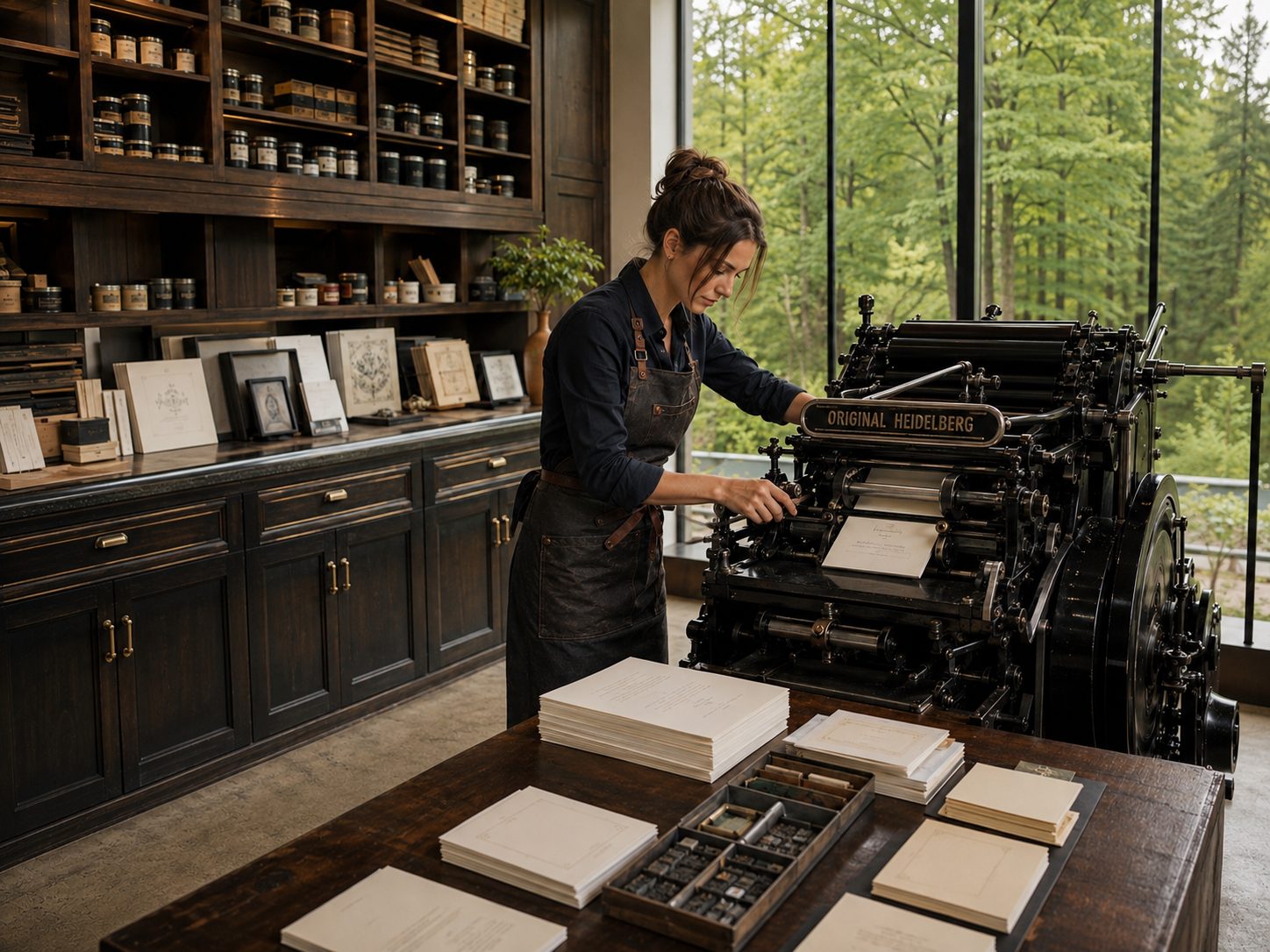
People imagine a letterpress shop as a place of constant printing — the press thundering away from morning coffee to closing time. The truth is stranger and better: printing is maybe a third of the day. The rest is ink chemistry, paper logistics, micrometer-level fiddling, and cleaning — a day that runs on rituals old enough that the machine's original 1950s manual describes most of them. Here's an honest tour of one, bell to bell.
Morning: ink by eye
The day starts at the glass slab, not the press. Ink comes in base colors and gets mixed by hand — knife, slab, and a formula book of past jobs — worked and folded like stiff butter until the color is even, then smeared thin on a scrap of the actual job stock, because ink lies on glass and tells the truth on cotton. The formula gets you close; the eye makes the call. Two shops with the same recipe will still argue over whether the hunter green is done. This half hour of knife work (the blue-stained rags on our bench are its permanent residue) decides the entire run: press problems can be fixed at the press; wrong color printed on five hundred cards cannot.
The unglamorous hour: makeready
The plate locks into its chase, the chase into the press bed — and then begins makeready, the hour visitors never photograph. Pull a proof. The impression is heavy on the left. Open the platen packing, cut a tissue-thin sheet to shape, add it behind the soft spot. Pull again. Now the descenders bite too deep. Adjust. Set the lay guides so every sheet lands within a hair of the same spot. Pull, squint under the raking light, adjust, pull. Ten proofs, sometimes twenty. Makeready is the actual craft; the run is just the reward for it — the difference between letterpress and merely crushed paper is decided entirely in this hour (the mechanics of it, here).
The run: rhythm and vigilance
Then the good part. The Windmill's gripper arms begin their rotation — feed, swing, press, deliver — and the shop fills with the press's four-beat rhythm, a sound printers can diagnose by ear the way mechanics hear engines. The work now is vigilant monotony: pull a sheet every fifty, check it against the approved proof under the light. Ink drifting thin? A quarter-turn at the fountain. And then the classic villain: the hickey — a fleck of dust or dried ink that lands on the plate and prints as a tiny haloed moon on every sheet after. The run stops, the plate gets wiped, the afflicted sheets go to the misprint pile. Sheet four hundred must match sheet four; that sentence is the whole job description.
Afternoon: the honest pile
Off the press, the cards rest, then head to the cutter for trimming to final size — corners checked, counts made, and always the misprint pile: the proofs, the hickey sheets, the makeready pulls. Every shop has one and every shop respects it; it's the visible cost of "one at a time" and the reason the good pile means something. (House use for ours: scratch paper, ink-test scraps, and the occasional brutally honest bookmark.)
Evening: the wash-up
The day ends in solvent. Fountain scraped, rollers washed until the rag comes up clean, the slab and knives scrubbed, tomorrow's stock cut and stacked. Wash-up is non-negotiable and slightly sacred — dried ink is the hickey factory of tomorrow, and a seventy-year-old press stays a working press precisely because every generation of its printers cleaned it like they meant to keep it. The shop's last smell of the day is solvent and cotton dust, which printers will tell you, unconvincingly, they don't love.
Why one sheet at a time, still
Tally the day: an hour of ink, an hour of makeready, the vigilant run, the honest pile, the wash-up — all so that a five-by-seven card can carry the evidence of it. That's the trade's whole answer to "why not just print digitally?" A letterpress card is a day's worth of human decisions pressed into cotton, and you can feel that, literally, in the impression. It's why the cards get kept (boxes exist for them), and why we keep making them this way — the long way, which turns out to be the point. Start at the beginning of the story: what letterpress is, and why cotton.